
Think Sea Salt Is Healthier? Think Again.
June 6, 2026
Have you ever chosen Sea Salt 🌊 over Table Salt 🧂 thinking it’s the healthier option? 🤔 You’re not alone!
For years, sea salt has been marketed as the more natural choice, while table salt often gets overlooked. But here’s the surprising truth: both are primarily made of sodium chloride, and the nutritional difference between them is much smaller than most people think. 😮
Table Salt 🧂 is refined and often fortified with iodine, an essential nutrient that supports healthy thyroid function. Sea Salt 🌊, on the other hand, is less processed and may contain trace minerals that contribute to its unique texture and flavor.
But here’s the real takeaway ✨: when it comes to your health, the amount of salt you consume matters far more than the type of salt you choose.
🌊🧂 Same destination, completely different journeys.
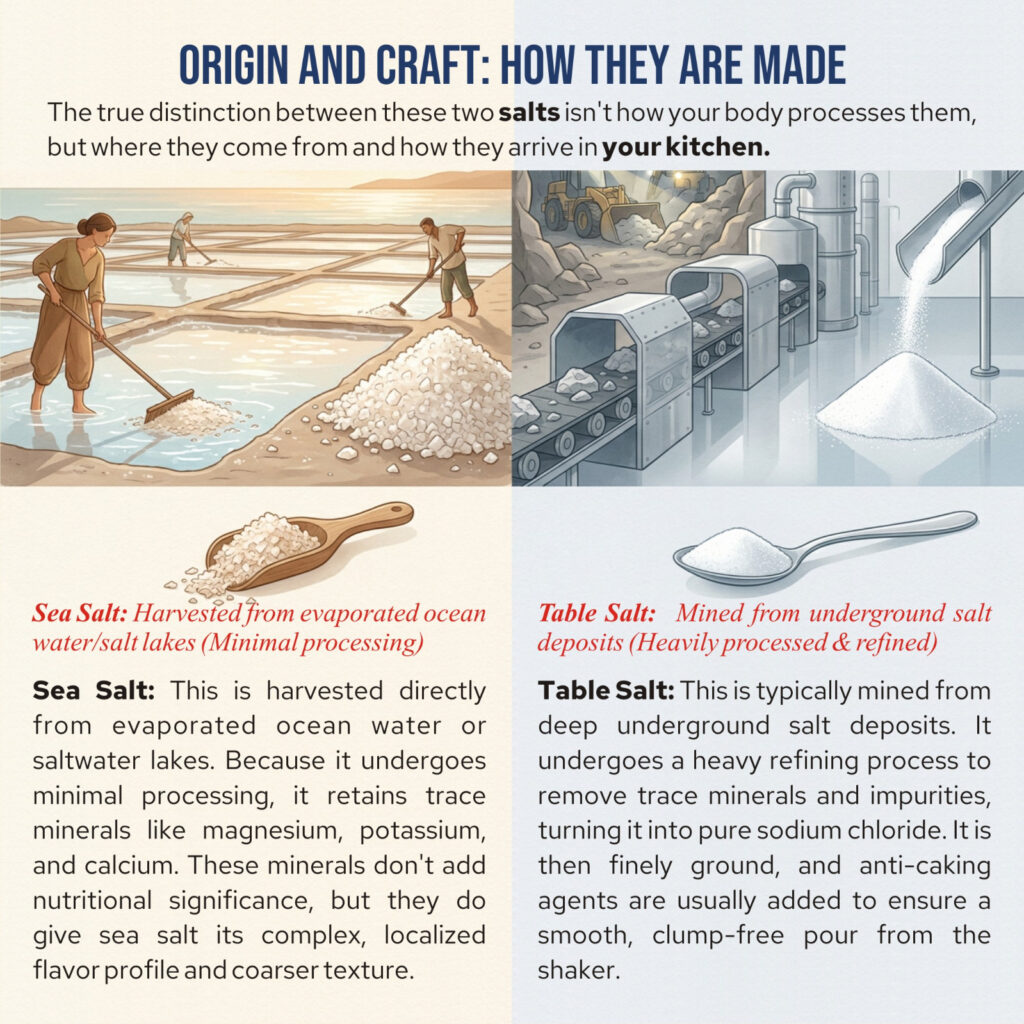
While Sea Salt and Table Salt may look similar on your dining table, their stories begin in very different places.
Sea Salt 🌊 is harvested from evaporated ocean water and salt lakes, undergoing minimal processing along the way. This allows it to retain tiny amounts of naturally occurring minerals, which contribute to its distinctive texture and subtle flavor variations.
Table Salt 🧂, on the other hand, starts deep underground. It is mined from salt deposits and then refined extensively to remove impurities and create the fine, uniform crystals most of us are familiar with. This process also gives it the smooth, free-flowing texture found in nearly every kitchen shaker.
✨ The biggest difference isn’t how your body uses them—it’s how they reach your plate.
🥄 Here’s a food fact that might surprise you: the “healthier salt” debate isn’t as dramatic as it’s often made out to be. 👀
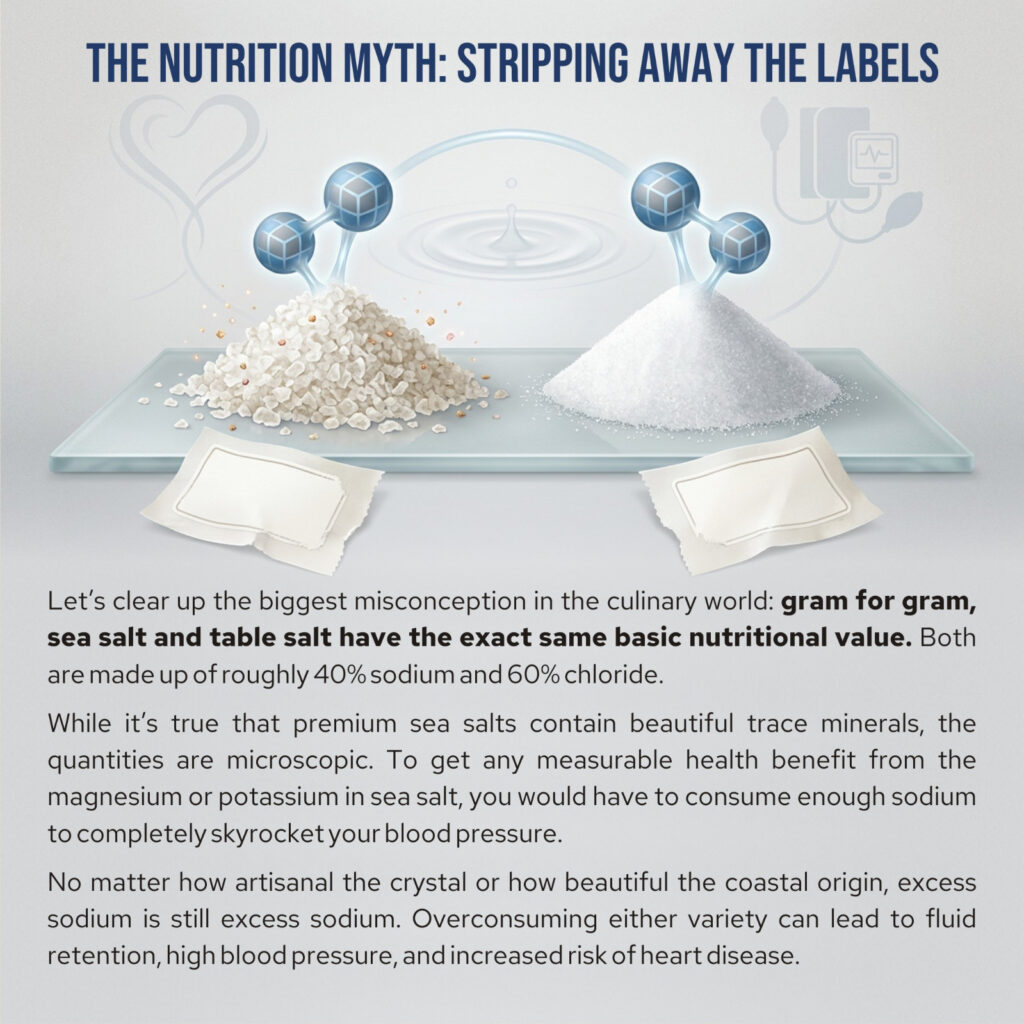
Many people assume that Sea Salt 🌊 is nutritionally superior to Table Salt 🧂, but when we strip away the labels and marketing, the reality is much simpler. Gram for gram, both contain nearly the same amount of sodium and provide essentially the same basic nutritional value.
Yes, sea salt contains trace minerals like magnesium and potassium ✨, but the amounts are so small that they don’t offer meaningful health benefits in the quantities we typically consume. In fact, you’d need to consume an unhealthy amount of salt before those minerals made any significant difference.
💡 The real concern isn’t which salt you choose—it’s how much you’re using.
Whether it’s artisanal sea salt or everyday table salt, excess sodium is still excess sodium. Too much of either can contribute to high blood pressure, fluid retention, and other health concerns. ❤️
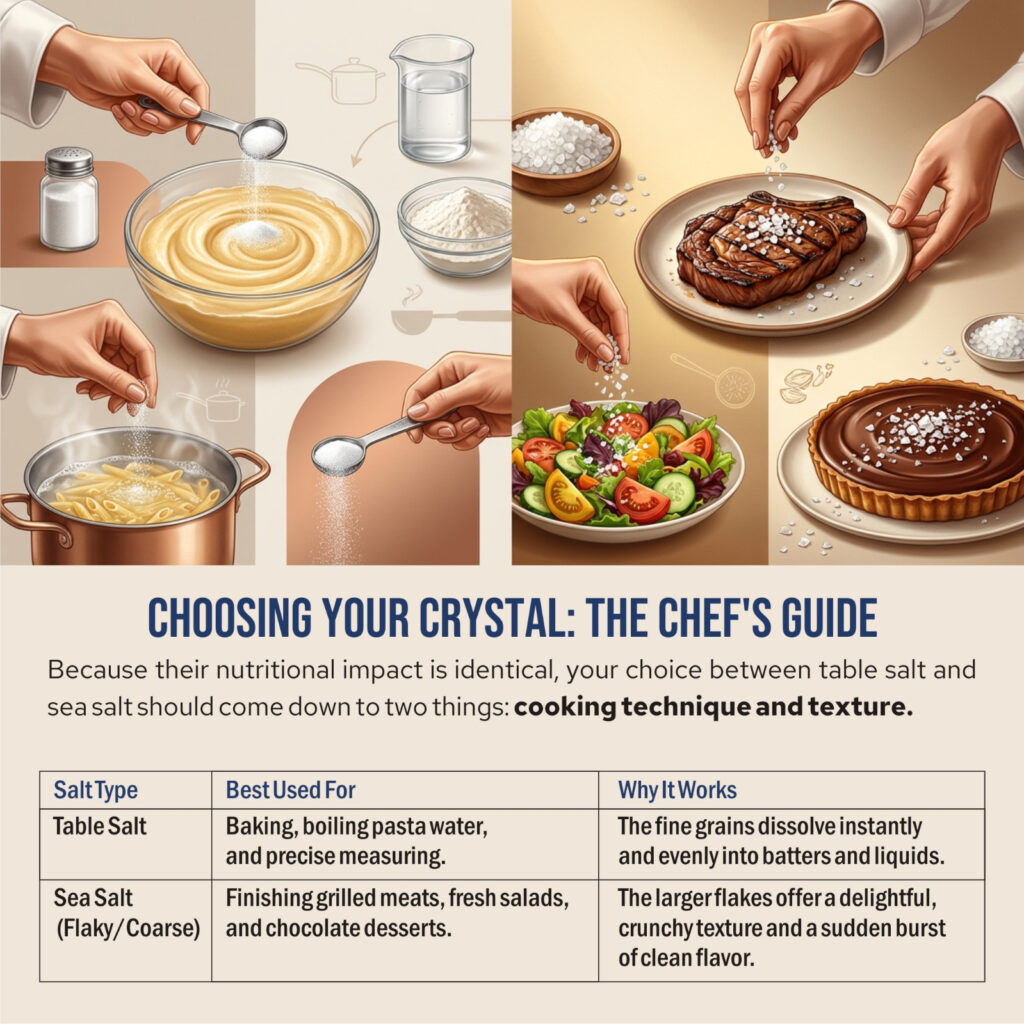
👨🍳🧂 Now that we’ve busted the nutrition myths, here’s the question that really matters: which salt should you actually use?
The answer isn’t about health—it’s about technique, texture, and the experience you want to create on the plate. ✨
Table Salt 🧂 is the reliable workhorse of the kitchen. Its fine crystals dissolve quickly and evenly, making it perfect for baking, boiling pasta, seasoning soups, and any recipe where precision matters. When consistency is key, table salt gets the job done every time.
Sea Salt 🌊, especially in its flaky or coarse form, shines as a finishing ingredient. A light sprinkle over a perfectly grilled steak 🥩, a fresh salad 🥗, or even a rich chocolate dessert 🍫 can add a delightful crunch and bursts of flavor that elevate the entire dish.
💡 Think of it this way: Table Salt builds the foundation, while Sea Salt adds the final touch of character.
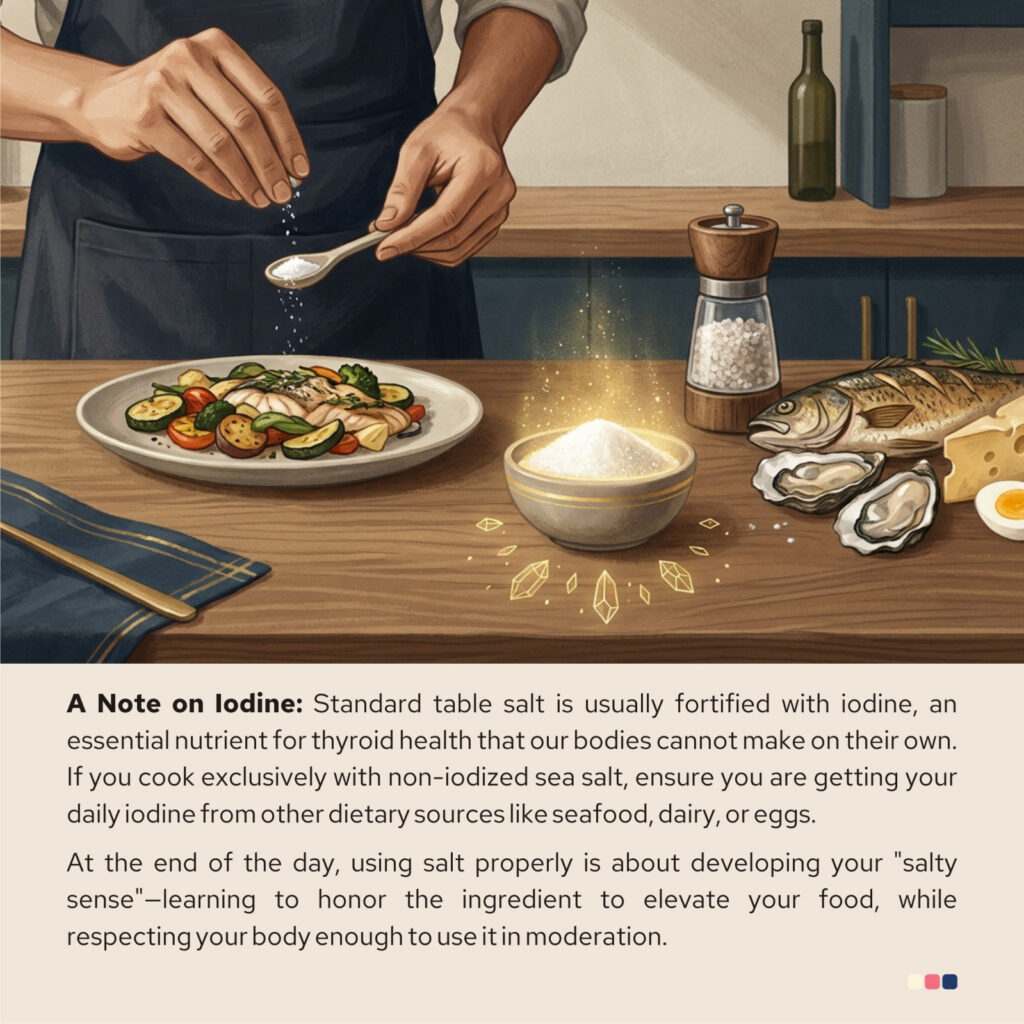
🧂✨ One final pinch of wisdom before we wrap up this salty debate…
When choosing between Sea Salt 🌊 and Table Salt 🧂, there’s one important detail that often gets overlooked: iodine.
Many varieties of Table Salt 🧂 are fortified with iodine, an essential nutrient that supports healthy thyroid function and helps keep your body’s metabolism running smoothly. Since our bodies can’t produce iodine on their own, we need to get it through food or fortified sources.
If you prefer using non-iodized Sea Salt 🌊, make sure you’re getting enough iodine from other foods such as 🐟 seafood, 🥚 eggs, 🥛 dairy products, or other iodine-rich sources.
💡 At the end of the day, the best salt isn’t about trends, labels, or fancy packaging—it’s about using the right salt for the right purpose and enjoying it in moderation.
That’s what developing your “Salty Sense” is all about: understanding your ingredients, making informed choices, and creating delicious food without overdoing it. 👨🍳❤️
🌟 So after everything we’ve discussed, what’s your takeaway?
Were you surprised by the similarities between Sea Salt and Table Salt, or has this changed the way you’ll use salt in your kitchen?


12 Comments
June 9, 2026
Annette3318
https://shorturl.fm/EZonP
June 11, 2026
Jude4983
https://shorturl.fm/tAqoX
June 28, 2026
Ronnib
Started reading expecting to disagree and ended mostly nodding along, and a look at tritonstyle continued the pattern, content that wins agreement through evidence and reasoning rather than rhetorical force is the kind that actually shifts minds and this site clearly knows how to do that across what I have read so far.
June 29, 2026
TylerTag
If I had to summarise the editorial sensibility of this site in a few words it would be careful and human, and a look at quietvoyage extended that summary feeling, capturing the essence of a sites approach in brief is hard but this site has a clear enough identity that the summary comes naturally enough.
July 1, 2026
Hassanham
Now feeling mildly impressed in a way I do not quite remember feeling about a blog in a while, and a stop at hoppyharbor extended that mild impression, content that produces specific positive emotional responses rather than just neutral information transfer is content with extra dimensions and this site has those extra dimensions clearly.
July 2, 2026
Vaughnturdy
Bookmark folder created specifically for this site, and a look at buildvelocitycleanly confirmed the dedicated folder was the right call, dedicated folders for individual sites are a level of organisation I rarely deploy and this site has earned that level of dedicated tracking based on the consistency I have seen so far across sessions.
July 5, 2026
DamienBaf
A piece that left me thinking I had been undercaring about the topic, and a look at signalcreatesmovement reinforced that mild concern, content that raises the appropriate weight of a subject without being preachy about it is doing important work and this site is providing that gentle elevation of attention for me consistently.
July 5, 2026
Eugenezooth
Nice and clean, that is the best way to describe the writing here, no clutter and no wasted words, and a quick visit to momentumunlocked kept that going, I appreciate when a site treats its readers like people who can think for themselves without needing constant hand holding through every paragraph.
July 7, 2026
Vernongit
Genuinely glad I clicked through to read this rather than skipping past, and a stop at growthpathbuilder confirmed I should keep clicking through to more pages here, the kind of resource that justifies its place in my browser history rather than feeling like wasted time which is the highest compliment I offer any site online today.
July 29, 2026
PeteFuh
Learned something from this without having to dig through layers of fluff, and a stop at clickforstrategicthinking added a bit more context that helped tie things together for me, definitely a useful corner of the internet for anyone who wants real information without the usual marketing nonsense around it that often ruins similar pages.
August 8, 2026
Lucia2248
https://shorturl.fm/I8yKT
August 16, 2026
Bradfordrip
A piece that reads like it was written for me without claiming to be written for me, and a look at websupreme produced the same fit, when the writer audience match clicks naturally without being engineered through demographic targeting you know the writing is solid and this site has that natural fit consistently for me.